Friday, July 27, 2007

Blog Envy


envy
Originally uploaded by bookgrl

I am really, really blessed to have this cool friend, Amy Butler who is not only really fun and funny and smart and a great fashion consultant, she's also another young woman pastor, and being friends with her makes me feel like maybe I am not so weird after all. Amy has had a blog for a while now and she's a really disciplined writer. She's very self-depricating about it all, but not only is her blog funny and poignent, but many of her entries are profoundly moving. I have even been brought to tears some of the things she has written.

So Amy has always been my blogging hero, and I know that the Bible says not to be envious, but I admit I am a little bit jealous of her blog. But then today she told me some news that made me really have blog envy: she might get published. And I don't mean on the internet (anyone can get "published" on the internet), I mean like in a BOOK! A writing agent in L.A. was forwarded some of her blog entries and she is trying to get them published!

Seriously, Amy, I am really excited for you and wish you all the best! Maybe someday I'll be as cool as you :)


Friday, July 20, 2007

Stage Fright

This is Ike Leggett with two girls from Woodside (Rachel, on the left, and Julia). I am not sure who took this photo or when, but I love it. It looks like Rachel is interviewing him, which, knowing her, she very well may be!

Last night Woodside opened our fellowship hall for a community "town hall meeting" with County Executive Isaiah "Ike" Leggett. For those of you who live outside of the DC area, the County Exec is kind of like the governor of Montgomery County in terms of his (or her) responsibility/power, the issues and numbers of constituents. So, basically, he's pretty much a big wig, but, I will say, that at least on a personal level Ike Leggett is a pretty nice guy. I respect the fact that he's willing to have these town hall meetings in the various communities in the County and open himself up to questions (and criticism) and there were plenty of both last night. It was exciting for Woodside to host such an event, too, and so I naturally took the opportunity to insert myself into the program (briefly) in order to, hopefully, give a positive impression of the church. I offered to give some words of welcome, an offer which the organizers readily embraced, but I am sorry to say, that, at least in my own estimation, I bombed.

Something happened when I got up in front of those 350 people which rarely happens to me any more, but still occasionally trips me up: I got stage fright. I am not sure if it was that I had been running around like a chicken with my head cut off, trying to be (literally) four places at once just before I got up to speak, or perhaps I hadn't really thought through was it was that I should say. Or maybe it was the fact that it was ridiculously hot in that fellowship hall and I was worried and embarrassed (disclaimer: the A/C was running full blast but they had brought in these TV lights and the place was packed, so it felt like it was about 90 degrees, and humid). Whatever it was, when I got the mic, I froze inside. I said some of the right things but all in the wrong way. And then I rushed off the stage as soon as I could. I even forgot to introduce the County Executive! Oh well, so much for making a good impression for the church.

Someone told me recently that public speaking is most people's number one fear--more than heights, or snakes, or enclosed places...even death! While most of the time it's not a problem for me, there are times when I do clam up. It helps to know, though, that I'm not alone!

Friday, June 29, 2007

The Church of Baseball?

"I believe in the Church of Baseball. I've tried all the major religions, and most of the minor ones. I've worshipped Buddha, Allah, Brahma, Vishnu, Siva, trees, mushrooms, and Isadora Duncan. I know things. For instance, there are 108 beads in a Catholic rosary and there are 108 stitches in a baseball. When I heard that, I gave Jesus a chance. But it just didn't work out between us. The Lord laid too much guilt on me. I prefer metaphysics to theology. You see, there's no guilt in baseball, and it's never boring..." Annie Savoy (from the movie Bull Durham).

In yesterday's Washington Post, columnist Marc Fisher wrote about the "unsavory mix of peanuts, cracker jacks and Jesus" at the Washington Nationals ballpark. He was specifically criticizing the initiative of a Christian marketing company to have "Faith nights" at major and minor league baseball games. The Washington Nationals will have their "Faith Night" on August 5th when the Nats play the St. Louis Cardinals, and for an extra $10 Christian fans will be able to hear a concert by the band MercyMe and meet Bob the Tomato and Larry the Cucumber from Veggie Tales.

Fisher's criticism of Faith Night was that it was exclusive to people of other faiths and that baseball is, in itself, a kind of religion (that's when he quoted the character Annie Savoy from the movie Bull Durham). The organizers of the event claim that it's no different from Realtors' Night, Disco Night, 4-H Night or Hispanic Heritage Night at the ballpark and that no one should take offense because all are welcome to come (or not). Of course, part of what is driving this critique has to do with the history of the Nats and their involvement with an evangelical chaplain program, Baseball Chapel, and the message that some of their chaplains were preaching about the eternal damnation of people of other faiths.

Now I am as PC as the next person, and I hear and understand these critiques about Christian exclusivity, and, honestly, I don't really buy it. Not when it comes to Faith Night anyway (the Baseball Chapel thing is a different story). That's not was offends me about "Faith Night." What really offends me is the idea that Christianity is something to be marketed in the first place. That our faith should be packaged and sold, promoted by animated characters, and that there's a group out there telling baseball execs that they should hold Christian Faith Nights because they can deliver "5,000-15,000 more in ticket sales" by holding a Christian rock concert at the ballpark. What would Jesus think about all this, do you suppose?

This week's Gospel lesson from the Revised Common Lectionary is from Luke 9:51-62. In it Jesus is heading toward Jerusalem where he will face his trial and execution, and he's talking with the disciples about what it means to follow him. And as usual, they don't get it. When some other folks come along and also want to follow Jesus he says: "Foxes have holes, and birds of the air have nests; but the Son of Man has nowhere to lay his head." To another he said, "Follow me." But he said, "Lord, first let me go and bury my father." But Jesus said to him, "Let the dead bury their own dead; but as for you, go and proclaim the kingdom of God." Another said, "I will follow you, Lord; but let me first say farewell to those at my home." Jesus said to him, "No one who puts a hand to the plow and looks back is fit for the kingdom of God."

I could be wrong (it's happened before) but I don't think Jesus is saying here that we should use baseball games as a way to bring people to Christ. I think he's saying that our Christian faith calls us to a life of worship and devotion, of sacrifice and service, of humility and compassion. Our faith is a way of life, not a product to be bought and sold, and exchanged when it doesn't meet our needs any more. And I think there's a very fine line between evangelism and "marketing," between being relevant and selling out. A Christian "faith night" at a baseball game should be different from Realtor's Night. Maybe instead of buying peanuts and cracker jacks, we could take up a collection to feed the hungry children of Washington, DC? Or organize people to walk from the ballpark to the Capitol to draw attention to the suffering of God's people in Darfur? Those might be more authentic ways to combine Christianity and a large secular sporting event.

Coincidentally, Marcus and I have tickets to this game on August 5th. Not because it's Faith Night, but because Marcus also worships the St. Louis Cardinals. We're going to worship at the Church of Baseball. But I'll let you know if we run into Bob the Tomato.


Monday, June 25, 2007

We're Expecting

Well, I made the big announcement in church yesterday...Marcus, Nora and I will be welcoming a new baby into our family around Christmas time!

Since there are already going to be four new babies in the nursery in the next six months, we figured we ought to do our part, too, to keep the church growing. So, make that FIVE new babies!

We are so excited (and nervous and anxious and tired already), and it was such a good feeling to hear from so many other folks at church how excited they are, too. Because it's a wonderful thing when a baby is born. Babies are signs of new life and hope. And babies also bring big changes. Things are a bit more chaotic for a while. There's less sleep, and lots more laundry. Eventually everything adjusts--we adapt, we survive, we learn how to cope. Even big sisters (so I hear). It's all a good thing. And what a blessing to have a supportive, caring community gathered around you when the new baby comes.

The funny thing, however, about the pastor having a baby is that it doesn't just affect one family system (the Meeks/Cornwell family will definitely be rocked!) but it affects the church family system, too. I will be away on maternityleave for 8 weeks, may possibly miss Christmas at Woodside all together, and there will be no one "in charge" while I am gone (not that I really have the delusion that I am ever really "in charge" even when I am there, right?)

So just like at home, at church we will plan and prepare, delegate and empower--I have already asked Dr. Warren Ebinger, beloved Pastor Emeritus, if he would be on call for Christmas and for pastoral care and some preaching while I am gone. We do the best we can to get ready, knowing that there will always be some things we can't anticipate. But we will adapt and survive and learn to cope. It's all a good thing! And what a blessing to have a supportive, caring community gathered around when a baby comes.


Baby being baptized
Originally uploaded by jaja_rita

Tuesday, June 05, 2007

Blood and Tears

Twice in the last three days Nora has had accidents that involved blood and tears.

On Sunday night, we were getting ready for bed and she was bouncing on her new "big girl" bed. Just as I was asking her not to do that ("you might fall and bump your...") she hit her chin and front teeth on the head board. First there was the bloody lip, then there was the inconsolable sobbing. She finally stopped crying when she just fell asleep in my arms about thirty minutes later.

Then tonight we went for a walk with Sojo along the Sligo Creek Trail and she was begging me to stop by the creek so she could throw some rocks in. So we stopped and she was standing on a big, stone block in the middle of the creek that--I realized too late--was a little wet and slippery. One good, strong toss and she ended up face down in the water, nose scraped, mouth bleeding, again, all wet. And more of the inconsolable sobbing. I finally got her calmed down enough to convince her to go back in the jogger so we could go home, but what had started out as a lovely evening, ended up with both of us wet and miserable.

It's wonderful being two years old. Nora has discovered that there are more and more things that she can do for herself, and her independent spirit is a beautiful thing. But I am also realizing more and more that, as her mother, I cannot protect her from everything. I can't prevent her from making mistakes, getting hurt, even falling on her face.

In her book The Year of Magical Thinking, Joan Didion writes about her daughter:
You're safe, I remember whispering to Quintana when I first saw her in the ICU and UCLA. I'm here. You're going to be all right...It occurred to me during those weeks that this had been, since the day we brought her home [as a baby] from St. John's hospital in Santa Monica my basic promise to her. She would be all right. It also occurred to me that this was a promise I could not keep. I could not always take care of her...Things happened in life that mothers could not prevent or fix.

Of course, Didion's daughter had a brain aneurysm and mine has a bloody lip and scrapes on her nose and chin, but it's still the same feeling. Things happen in life that mothers cannot prevent or fix. And it's really scary and painful to realize that. Because I love my child more than anything in the world. I never want her to experience pain or suffering. But she does and will, and I can't do a damn thing about it.

And then I wonder--is this how God feels about us?

I will be the first one to admit that the parental metaphor for God is limited and, at times, unhelpful--even hurtful--for some people. But then there are other times when, as a parent, I think, if I love my child this much, and want to protect her and comfort her and see her live and grow and thrive this much...how much more does God want that for us?

I feel certain there are times when God watches us doing something and thinks don't do that you're going to fall and bump your...oh, ouch. And yet God loves us enough to let us be free to mess up, to fall on our faces, to bump our chins. And when we cry inconsolably, God's there, too, ready to wipe away the tears.


Look, God’s home is now among his people! He will live with them, and they will be his people. God himself will be with them. He will wipe every tear from their eyes, and there will be no more death or sorrow or crying or pain. All these things are gone forever.
Revelation 21:3-4 (New Living Translation)

Thursday, May 31, 2007

The Un-tied Methodist Church

Last week was the Baltimore-Washington Annual Conference, and it was a saddening and discouraging conference in many ways. Although Annual Conference is supposed to be about "holy conferencing" or the open, respectful, prayerful dialogue that happens by the power of the Spirit, there was a lot of politics, distrust, fear, and division.

One of the most disappointing things to me was that a petition to remove the language from our Book of Discipline that says "we do not condone the practice of homosexuality and believe that the practice of homosexuality is incompatible with Christian teachings" was defeated. I believe that this language needs to be removed because I do not believe that homosexuality, in and of itself is "incompatible" with Christianity. There are all kinds of sexual immorality (try adultery, promiscuous sexual behavior outside of marriage, child abuse), and there are also plenty of sexually ethical and moral gay people in loving, healthy, committed, monogamous relationships. There are scriptures that refer to homosexual sex as "an abomination" to God, but there are also scriptures that say that women should be silent in church, that condones slavery, that we should not eat shellfish because it is an "abomination," but somehow we have found ways to exegete and interpret these verses. It's only the scriptures that refer to homosexuality that we continue to read literally.

But perhaps even more disheartening to me than the failure of our conference to pass this petition, was the total lack of conversation around the issue. Both sides continue to talk past each other--not responding to the other's concerns, not really hearing what the other has to say.

There were also a lot of politics--and I guess I should have expected that, since it's the year before our General Conference and we were electing delegates to represent us there, and this is Washington, after all. But it wasn't politics in the good sense, it was nasty, distrustful, are-you-with-us-or-against-us kind of stuff. Yuck.

There were good things about Conference--it wasn't all bad. There was a really challenging and inspiring Bible study presented by the pastor and some members of the Hot Metal Bridge Faith Community in Pittsburgh who challenged us to rethink the mission and purpose of the church. And the music was AWESOME. Mark A. Miller and his band "Subject to Change" gave us the most uplifting, fun music we have had in years.

In fact, the last song we sang at conference, during the ordination service was one that went something like this: I need you, you need me, we are a part of God's body. Stand with me, agree with me, you are a part of me, I need you to survive.

And I burst into tears at that point, wondering how we could sing this after all that had happened and the ugliness and division that was so rampant in the church right now. My friend Ginger put her arm around me and said, "We keep singing it until we can live it."

Yes, we will. We must. Just keep singing.


Fractured
Originally uploaded by peglegmeggg

Monday, May 14, 2007

Humility Embodied

Last week I spent four days at a conference in Indianapolis, IN, for young (or, rather, novice) clergy. Indianapolis is home of Eli Lilly, the makers of Prozac and other pharmaceuticals, whose endowment funds many good causes, including numerous Transition into Ministry programs like the one that I was part of the past two years. It was exciting to be around 80 other young pastors who were in their first 1-5 years of ministry and who are as passionate, committed, and energized as I am (on my good days).

But the best part of the conference was to hear from Pastor Heidi Neumark, a Lutheran Pastor in New York City who has written one of the best books on the pastoral life that I have ever read.

For nineteen years, Neumark pastored the Lutheran Church of the Transfiguration in the South Bronx, an economically depressed, drug and crime ridden part of the city. And yet, her book, and her ministry is so full of hope! After reading this book, I thought, this woman is amazing. And she is, but the picture I had of her in my mind was totally different from who she is in real life.

I don't know why, but I expected someone who embodied boldness--someone who would be strongly spoken, visibly passionate, charismatic. But Heidi (although clearly strong and passionate, and charismatic in her own way) was not at all as I expected her. Instead, the word I would use to describe her would be humble. She was soft spoken, clearly very introverted, and embodied humility, from they way she dressed, to the self-depricating way that she described her ministry. It was such a helpful reminder to me that there is not one personality that reflects successful pastoral ministry (we don't all have to be Rick Warren--thank you Jesus.) and what a beautiful and powerful fruit of the Spirit humility is. It's not a quality you see much of--not even among pastors--and it was interesting to note how uncomfortable Heidi's deep humility made some people. But it's a gift I wish I had more of.

By the way, I strongly encourage you to read her book, Breathing Space: A Spiritual Journey Through the South Bronx (and if you buy it through this Amazon link, Woodside church gets a little commission...:)


Saturday, May 12, 2007

Soul Tending


When I need to feed my soul, the best place for me to do that is the beach. The sound of the surf, the smell of salt air, sand between my toes...it relaxes, restores, refeshes me. (See picture at left of Nora and me on the beach at Assateague last summer).
Marcus, on the other hand, is a mountain man.

For him, relaxing is packing up the tent, the backpacks and the dog and heading for the hills to hike and sleep beneath the stars. (This other picture is actually from our trip to Colorado in January, but you get the point.)
The past two weekends we have been blessed to get to do both of these things that we love. Last weekend we made a quick trip to a friend's beach house in Fenwick Island, MD. (It's so great to have generous friends...and even better to have generous friends with beach houses!) It was so good to get away just for a couple of days, and I came back feeling like a new person.
And this morning we went to hike on Sugarloaf Mountain. It was so fun seeing Nora climb all over the rocks (so far we are not sure if she prefers the beach or the mountains...she is terrified of the waves, but also of caterpillars), and we got to take in some beautiful views, have a picnic lunch and even happened upon a little festival at the Sugarloaf Mountain Vineyard where we got ice cream and Marcus enjoyed the free wine tasting.
I just share this because I feel so lucky to have had these two brief, but fun and relaxing little excursions with my family the past two weekends. It has fed our souls!

Wednesday, May 02, 2007

Could you eat on $21 per week?

Tonight at church we had a presentation by Erin Luchenbill on Bread for the World's campaign to reform the Farm Bill. Here are some of the things we learned:

  • 35 million people in the US are at risk of hunger, including 12 million children;
  • The Farm Bill, which was originally created during the depression to support 25% of Americans who were farmers, today assists less than 1% of the population;
  • 2/3 of farmers do not receive any assistance through the Farm Bill; the ones who do are mostly corporate farms;

There is tremendous poverty in rural America because of unemployment and lack of economic opportunity. Many people who used to farm are being bought out by large corporate farms, and now there are millions of people in rural America who depend on food stamps to feed themselves and their families. The average food stamp benefit is $1 per person, per meal--$21 per week. How many of us could survive on $21 each week?

And in addition, because of farm subsidies which create a glut of crops such as cotton and corn, which are then sold cheaply on the world market, our current farm assistance policies are hurting farmers in developing countries.

Bread for the World is encouraging people to write a letter to their member of Congress urging them to pass broad reforms to the existing Farm Bill. I would strongly encourage you to learn more and take action by visiting the Bread for the World website. This is a justice issue for us as Christians and it is possible for us to eliminate hunger if we are willing to use our voice for change.


food stamp brochure
Originally uploaded by africankelli.

Saturday, April 21, 2007

What's on God's iPod?


iPod
Originally uploaded by Eric Hudon.


As someone who spends far more time writing and preaching sermons than listening to them, I find myself needing to find other ways and other voices which give me the opportunity to hear and understand the word, and believe again. One of the ways I do this is through music. Anyone who has been to church knows that there are times when a hymn or other piece of music can sometimes proclaim the Gospel more clearly, more honestly that a spoken sermon. But Friday night I heard one of the best sermons I've heard in a while--not in church, but at the Ram's Head Tavern in Annapolis. The Ram's Head is a wonderful, intimate concert venue, and Marcus and I went on a date--yes, a real date!--to hear a band called Over the Rhine. They're a great sort of country/jazz/folk/soul band--piano, guitar, bass, drums and a lead singer, Karin Bergquist, whose voice is nothing short of amazing.

Before one of their songs, the piano/guitarist, Linford Deitweiler, mentioned that he had grown up around a lot of church music--his father had been a travelling evangelist. And he asked the theoretical question: what do you think is on God's iPod anyway? If God is looking for suggestions, I recommend getting this one off iTunes.

It was the second song they sang, a song called "Long Lost Brother" that goes like this:

I thought that we'd be further along by now I can't remember how we stumbled to this place
I loved you like a long lost brother On a bad day maybe I thought why bother I've seldom seen so much anger in a face
I wanna do better; I wanna try harder; I wanna believe, down to the letter
Jesus and Mary, can you carry us Across this ocean into the arms of forgiveness
I don't mean to laugh out loud; I'm trying to come clean, trying to shed my doubt Maybe I should just keep my big mouth shut
More often than not when it comes to you You want whatever's not in front of you Deep down I know this includes me too
So tell me your troubles let your pain rain down I know my job I've been around; I invest in the mess, I'm a low cost dumping ground
Trouble is I'm so exhausted The plot, you see, I think I've lost it I need the grace to find what can't be found.
(Words and Music by Linford Detweiler)

To me, it's a song about longing, about the brokeness of human relationships, about our need for grace and forgiveness. In other words: the Gospel. This song preached to me through it's honesty, and through it's glimpse of hope. Not exactly what I expected to get on a Friday night at the Ram's Head Tavern. But I guess it just goes to show, the Spirit of God is truly everywhere--moving through life with creation's soundtrack on the holy iPod.

Sunday, March 18, 2007

Wasted Time


This was a week of futile efforts and wasted time.

This week I wasted an entire afternoon sitting in and around a State Senate hearing room waiting to testify in support of a bill to allow home-based day care providers to organize. I went to Annapolis, dressed in my clerical collar and all, and there we waited three hours, through panel after panel of people speaking in favor and against a different bill. I had to leave before they even got to the bill on which I had been asked to speak.

On Friday evening my family and I went to the airport to catch a flight to Phoenix for my grandfather's 80th birthday party. The shuttle bus driver picked us up in the parking lot and asked what airline we were on, and when we told him, he just laughed. There was a mix of snow and sleet falling and they were cancelling flights across the board. Ours was still scheduled to go, so we got our boarding passes, our airport dinner, and then went to the gate where we waited for an hour and a half with an exhausted toddler before they cancelled our flight (and sent our luggage on to Phoenix anyway). And with no available seats to Phoenix on any flight on Saturday, we weren't able to go at all, which was really disappointing.

I am not the kind of person who likes wasting time. It's so frustrating for me because I view time as so precious. And I usually pack my schedule so that I am never idle. So when I wasted all this time this week on these two fruitless endeavors, I was really cranky. What was the point? I thought. How could I have done things differently so that this wouldn't have happened. I was kicking myself for having wasted so much time and for having gotten nothing for it. Or so I thought.

Perhaps this week was a lesson in waiting, in patience, in the blessing of wasted time. Now I wouldn't go so far as to say that God arranged this week's events intentionally to slow me down. I think God would like me (and all of us, really) to relax and stop moving at a breakneck pace--it's the whole reason why God commanded us to observe a Sabbath--but I don't think God is going to make me do it. It's my choice--free will and all that. But I have another choice, too. I have the choice between getting mad and frustrated and irritated and stewing about wasted time, or of viewing these two experiences as a sign that I need to slow down, to appreciate the moments and days that are fleeting by. To appreciate people, relationships, life, the world around us.

Even the best laid plans sometimes go ary and there's not a thing we can do about it. Sometimes we are forced to wait, or turn around, to waste time. But I am trying to look more carefully at how I spend my time, and how I view time in general. It's possible that there's no such thing as "wasted time." During those hours waiting for that hearing, I got to talk with a lot of interesting people, and I got some reading done. During our wait at the airport, we got to meet the former Supreme Court Justice Sandra Day O'Connor and I got to knit, and then I ended up with a free Saturday that I got to spend with the two people I love best in the world.

Maybe there's no such thing as wasted time, unless, of course, we mean the time we spend wishing we could be somewhere else, doing something else.

Sunday, February 25, 2007

Wedding Blessing

I recently had the privilege of giving a wedding blessing for a unique couple. Jeremy and Kristina were married more than two years ago in London, but since she has Ukranian citizenship, she only just last month received her visa to come and live in the US. They met through an internet dating site and began chatting on-line with each other, then they started talking on the phone every day. In 2004, Jeremy went to London to meet Kristina for the first time face to face, and he proposed to her. They were married in a civil ceremony because Kristina's priest wouldn't officiate the ceremony. So when she arrived here and Jeremy's parents wanted to throw a reception for them, they wanted a clergy person to come and bless their marriage, and I was invited to give the blessing by a member of Woodside who is a close friend of the family.

The story of Jeremy and Kristina's meeting, on-line courtship, trials with immigration and the church are all pretty interesting and pretty uncommon, at least in my experience. But there's one more thing about this couple that's different from other weddings I have been a part of. Kristina and Jeremy both have cerbal palsy. Although they have the same disAbility, it affects them each differently. Kristina uses a wheelchair to get around, but Jeremy, with the help of crutches or a walker, can walk pretty well. Jeremy is severely visually impaired, but Kristina can see.

Any good marriage is based on the willingness of each partner to support the other through difficulty, to complement each other's weaknesses, and enhance each other's gifts and strengths. And in this way Jeremy and Kristina are just like every other couple whose marriages I have joyfully blessed, and their well-suitedness for each other is an inspiration. Congratulations, Jeremy and Kristina. May God bless your life together!

Tuesday, February 13, 2007

Interfaith Dialogue

Our Confirmation class is participating in an interfaith program called "Children of Abraham" with other middle school students who are Jewish and Muslim. From what I can see, thus far it's been a great experience for our confirmands--a chance for them to learn about other faiths while also growing into their own. In addition to the program for the youth, the organizers have also developed a parallel program for the parents and other adults, which I went to for the first time on Saturday evening. I learned a lot--a lot of facts that I didn't know, especially about Islam, but I learned the most, I think, just from the interactions.

There were five of us Christians (all Methodists), two liberal Jews and two Muslim women. That's pretty much how the students break down, too--about half the group is Methodist, and the other half is about equally divided between Muslims and Jews. I was thinking about this lopsidedness on the part of the Christians and I think it's because for us interfaith dialogue isn't all that risky. We are the majority religion in this country, numerically, but in other ways, too, and for us, we don't have much to lose.

But what I noticed, particularly with the Muslim women, they seemed to be taking a big risk. Since September 11th, Muslims in this country (and in most of the world, really) have been put under a microscope. Sometimes the motivation to look more closely has been positive, like in this program, because we want to learn more about this religion and join together with moderate Muslims to combat fundamentalism of all kinds.

But other sorts of scrutiny are less benign. Especially since September 11th, many people have begun to look at Muslims with suspicion, fear, even hatred. And sometimes in these interfaith dialogues moderate Muslims are expected to speak for the whole faith, to respond to, even take responsibility for fundamentalists and terrorism.

It seemed to me that there was some fear about this kind of scrutiny on the part of our Muslim participants. They seemed reticent to talk, to share, to fully participate. During one exercise when we were asked to imagine and draw images of interfaith peace, they didn't do it. I am not entirely sure why, but from the explanation that one of the women gave, it seemed to me that she had a hard time even imagining what interfaith peace might look like. And that made me feel very sad.

Overall, I think that interfaith dialogues are a positive thing. When they are done right, they are hard work, but that's good. We need to work hard at this--the future of our world depends on it.

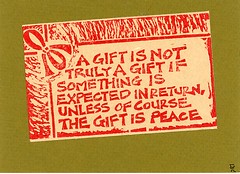
One of the exercises that the youth did together last Saturday was plant flower seeds. They wrote prayers for peace on the sides of the flower pots and then traded them with each other. They are supposed to tend to these seeds, to nurture them so they will grow. I pray that these will not be the only seed that are planted in them, and that out of this experience will grow peace.


Gift of Peace
Originally uploaded by YardSale.

Saturday, February 10, 2007

In case you had lost faith in humanity

Sure, there are lots of reasons to be cynical about your fellow (hu)man. Crime, war, random acts of violence...you name it. We get jaded and begin to think that it's a rare day when people do things that are nice, or selfless, or honest. Well, here's a little thing that helped restore my faith in humanity, just a little bit yesterday.

I was meeting a friend/church member at the Savory in Takoma Park for coffee yesterday morning and I parked at the Takoma Metro Station. I was in a rush (running late as usual) and I jumped out of my car, dashed over to the meter and dropped in my quarter. But when I did it made a strange sound, and I looked down to see that the part that catches and contains the coins (what in the heck do you call that thing? the bank?), well, it was broken. The front of the meter had broken off (or been broken off--who knows) and someone had just set it inside the meter. But the best part was that there was probably ten dollars in quarters in there, and no one had taken them!

When I saw that it was broken, I thought for a split second hey, I could take my quarter back! Just think about all the money I have put into broken meters and lost...It was like those old cartoons with the angel sitting on one shoulder and the devil sitting on the other, offering competing advice. But I was so impressed that so many other people had gone ahead and put their quarters into this broken meter, and that no one had taken this money. I mean it was just sitting there, begging to be carted off to washers, dryers and vending machines. So, I just paid my quarter, and went off to my coffee date. It's a little thing, I know, but the whole experience made me feel a little better about the human community afterall.

Wednesday, January 31, 2007

U2charist

I recently heard about a worship idea that churches around the world are doing--it's called the U2charist. It started at a church in Maine, when they put together a eucharist service with the music of the rock band U2 and took up a collection for the ONE campaign, a crusade against global poverty and AIDS. U2, and especially their lead singer, Bono, has become known lately for their advocacy on behalf of the poorest of the poor. Last year Bono spoke (or I would say, preached) at the White House prayer breakfast on the need for greater awareness and action on behalf of the world's most impoverished people. But anyone who has listened to their music for a while knows that this passion for justice is nothing new. For years they have written powerful songs about the hope for peace in Northern Ireland ("Sunday Bloody Sunday") about Dr. Martin Luther King, Jr. ("Pride (In the Name of Love)") and their passion comes from their grounding in the Christian faith. So listening to U2 in church, while perhaps a bit unconventional, is not in the least bit heretical.

But what does U2, and the fight against global poverty, have to do with the eucharist? There have been some side conversations about communion at church lately--about the way that people feel we ought to do it (with individual servings of bread and juice? or by intinction?), about who should serve it (anyone? or only the pastor and people who are specifically "trained" for it?) and about what it means (the questions here are less clear, however...). When we celebrate holy communion, it is a reenactment of the last supper that Jesus had with his closest friends. Through the symbols of bread and wine, Jesus tried to explain what his death and resurrection were going to mean--that through his sacrifice all the world would be offered redemption for their sins and new life. When we participate in the eucharist we are made one with Christ and one with each other. It is not how we take communion that's significant, but rather what happens when we do. We are healed from our brokeness, reconciled with one another, and called to new life in Christ. Transformation is inherent in the sacrament of communion. So of course a call to justice, a call for liberation and healing for the world's poor, and music that awakens our conscience and our soul could, no, should be part of a eucharist service. Why not?

So, coming soon to Woodside...the U2charist?


Thursday, December 28, 2006

The Secret of the Gifts

The Secret of the Gifts: A Story by Paul Flucke

The story has been told for centuries now. The story of Gaspar, Melchior and Balthasar, and the gifts they brought to the newborn king. And of how they saw the star and followed it for weeks across mountain and valley and desert. In stately procession on their swaying beasts, the came and placed their treasures at the feet of the infant Savior.

And what were their gifts? Ah, you say, everyone knows that. They brought gold, frankincense and myrrh. So, since the earliest of days, the story has been told.

But there you are wrong. The story in incomplete. You see the story was told by those who had seen the wise men on their journey. And by those who stood in wonderment as the wise men dismounted from their weary camels and strode to the door of the rude stable. They watched as the wise men held their jeweled caskets high before them. That much the world saw. So the story has been told.

But that is not the whole story. And if you listen carefully and very quietly, you shall hear the rest of it. You shall hear what happened when the wise men entered the stable. And you shall learn the secret of the gifts.

Gaspar

The first of the three visitors to approach the stable was Gaspar. His cloak was of the finest velvet, trimmed with flawless fur. At his waist and throat were clusters of gems, for Gaspar was a wealthy man.

Those who watched saw only that he paused at the stable door. "He prays," they whispered to one another as they saw Gaspar's lips move. But they were mistaken. They could not see that it was the angel Gabriel, guarding the holy place, before whom Gaspar stopped.

"And who are you?" Gabriel asked in a voice that was firm but not unkind.

"I am Gaspar, and I come to worship the king," he replied.

"All who enter here must bring a gift," said Gabriel, "have you a gift?"

"Indeed I have," said Gaspar, and he held aloft a finely wrought box. It was small, yet so heavy that his arms could hardly raise it. "I have brought bars of the finest gold."

"Your gift," said Gabriel somberly, "must be the essence of yourself. It must be something precious to your soul."

"Such have I brought," answered Gaspar confidently, the hint of a smile upon his lips.

"So shall it be," said Gabriel. And he too smiled as the held the door for Gaspar to enter.

And there before the rough board wall of the stable, lay the king he had traveled so far to see. The light of the lamp fell across the tiny face and glinted back from the dark, bright eyes. In the shadows sat the parents, motionless and silent. And beyond them, Gaspar sensed the presence of sheep and oxen who stood their reverent watch.

Gaspar advanced a step and then another. He was just about to lay his gold before the child when he stopped and stood erect. There in his outstretched hand lay not gold, but a hammer. Its scarred and blackened head was larger than a man's fist. And its handle was of sinewy wood as long as a man's forearm.

But, but--" Gaspar stammered as he stared, dumbfounded, at the heavy tool. And then softly, from behind him, he heard the voice of Gabriel.

"So shall it be, and so it is," said the angel, "You have brought the essence of yourself."

Gaspar turned indignantly. "A hammer? What foul magic is this?"

"None but the magic of truth," replied Gabriel. "What you hold in your hands is the hammer of your greed. You have used it to pound wealth from those who labor so that you may live in luxury. You have used it to build a mansion for yourself while others dwell in hovels. You have raised it against friends and made them into enemies--and against enemies to destroy them."

And suddenly Gaspar knew the truth. Bowed with shame, he turned toward the door to leave. But Gabriel blocked his way. "No, no," he said, "you have not offered your gift."

"Give this?" Gaspar blurted in horror, looking at the hammer. "I cannot give this to a king!"

"But you must," Gabriel replied. "That is why you came. And you cannot take it back with you. It is too heavy. You have carried it for many years, and even now your arms ache with its weight. You must leave it here or it will destroy you."

And once again Gaspar knew the angel spoke the truth. But still he protested, "The hammer is too heavy," he said, "Why, the child cannot lift it."

"He is the only one who can," replied the angel.

"But it is dangerous. He might bruise his hands or feet."

"That worry," said Gabriel, "You must leave to heaven. The hammer shall find its place."

Slowly Gaspar turned to where the Christ child lay. And slowly he placed the ugly hammer at the baby's feet. Then he rose and turned to the door, pausing only for an instant to look back at the tiny Savior before he rushed outside.

The waiting world saw only the smile that wreathed Gaspar's face as he emerged from the stable. His hands were raised, as though the wings of angels graced his fingers. That much the world saw, and so the story is told.

Melchior

Net to step to the door of the stable was Melchior, the learned Melchior. He was not so resplendent as Gaspar for he wore the darker robes of a scholar. But the length of his beard and the furrows of his brow bespoke of once who had lived long with the wisdom of the ages. A hush fell over the onlookers as he too paused before the door. But only Melchior could see the angel who stood guard. Only Melchior could hear him speak.

"What have you brought?" asked Gabriel.

And Melchior replied, "I bring frankincense, the fragrance of hidden lands and bygone days."

"Your gift," cautioned Gabriel as he had done before, "Must be something that is precious to your soul."

"Of course it is," restored Melchior.

"Then enter, and we shall see." And Gabriel opened the door.

Melchior stood breathless before the scene within. In all his many years of searching for elusive Truth, he had never sensed such a presence as this. He knelt reverently. And from beneath his robe he withdrew the silver flask of precious ointment.

But then he drew back and stared. The vessel in his hand was not silver at all. It was common clay, rough and stained as might be found in the humblest cupboard. Aghast, he pulled the stopper from its mouth and sniffed the contents. Then he leapt to his feet only to face the angel at the door.

"I have been tricked," he said, spitting the words with fury, "this is not the frankincense I brought!"

"What is it, then?" asked Gabriel.

"It is vinegar!" Melchior snarled as though it were a curse.

"So shall it be, and so it is," said Gabriel, "you have brought what you are made of."

"You are an angel of fools," Melchior snorted.

But Gabriel went on. "You bring the bitterness of your heart, the soured wine of a life turned grim with jealousy and hate. You have carried within you the memory of old hurts. You have hoarded your resentments and breathed on sparks of anger until they have become as embers smoldering within you. You have sought for knowledge. But have filled your life with poison."

As he heard these words, Melchior's shoulders dropped. He turned his face away from Gabriel and fumbled with his robe, as though to hide the earthen jar. Silently he sidled toward the door.

Gabriel smiled gently and placed his hand on Melchior's arm. "Wait," he said, "You must leave your gift."

Melchior sighed with a pain that came from deep within him. "How I wish I could. How long have I yearned to empty my soul of its bitterness. You have spoken the truth, my friend. But I cannot leave it here. Not at the feet of love and innocence."

"But you can," said Gabriel, "and you must, if you would be clean. This is the only place you can leave it."

"But this is vile and bitter stuff," Melchior protested. "What if the child should touch it to his lips?"

"You must leave that worry to heaven," Gabriel replied. "There is a use even for vinegar."

So Melchior placed his gift before the Savior. And they say that when he came out of his stable, his eyes shone with the clearest light of heaven's truth. His skin was as smooth as a youth's as he lifted his face to gaze on horizons he had never seen before. And in that, at least, the story is correct.

Balthasar

There was yet one more visitor to make his offering. He strode forward now, his back as straight as a tree, shoulders firm as an oaken beam. He walked as one born to command. This was Balthasar, leader of many legions, scourge of walled cities. Before him, as he grasped it by its handle of polished ebony, he carried a brass-bound box.

A murmur ran though those who watched as they saw him hesitate before the door. "Look," they whispered, "even the great Balthasar does obeisance before the king who waits within."

But we know that it was Gabriel who caused the warrior to pause. And we know too the question that he put.

"Have you a gift?"

"Of course," answered Balthasar. "I bring a gift of myrrh, the most precious booty of my boldest conquest. Many have fought and died for centuries for such as this. It is the essence of the rarest herb."

"But is it the essence of yourself?" asked Gabriel.

"It is," replied the general.

"Then come," said the angel, "and we shall see."

Even the fearless Balthasar was not prepared for the wave of awe that struck him as he entered the holy place of the Christ child. He felt a weakness in his knees such as he had never known before. Closing his eyes, he knelt and shuffled forward through the straw in reverence. Then bowing until his face was near the ground, he slowly released his grip upon the handle of the box and raised his head and opened his eyes.

What lay before him at the baby's feet was his own spear. Its smooth round staff still glistened where the sweat of his palms had moistened it. And the razor edges of its steely tip caught the flickering light of the lamp.

"It cannot be!" Balthasar whispered hoarsely. "Some enemy has cast a spell."

"That is more true than you know," said Gabriel softly from behind him. "A thousand enemies have cast their spell on you and turned your soul into a spear."

"You speak in riddles," cried Balthasar, turning to face the angel. "I'll teach you not to jest at a time like this." And he raised his fist as if to strike.

Gabriel did not flinch as he continued. "Living only to conquer, you have been conquered. Each battle you win leads you only to another with a foe yet more formidable."

"Do you think I like to kill?" demanded Balthasar. "You angels know nothing of this world. I am the defender of my people. Were it not for my spear leading them in battle, we should have been destroyed long ago. Why, even now, the enemy is massing to invade us. As soon as I leave this holy place, I must raise more armies. I must buy more spears to arm them and--"

"More," Gabriel interrupted quietly, "than what?"

"Why, more than we have now. More than our enemies have."

"And what will they do then?" asked the angel softly. "Will your enemies too need more?"

Balthasar heard the angel's words and they seemed to echo in the deepest places of his soul as though vaguely familiar. Was the question one that he had sometime asked himself? Was it that faintest flicker of doubt, quickly stifled by one who did not dare to doubt?

For a moment, Balthasar hesitated. Then taking control of himself, he reached down and grasped his spear--and turned toward the door.

"I cannot leave this here," he said. "My people need it. We cannot afford to give it up."

"Are you sure," asked Gabriel, "that you can afford to keep it?"

"But our enemies will destroy us if we drop our spears," Balthasar replied impatiently. "We cannot take that risk."

"Yes, it is a risk," Gabriel replied slowly. "But your way is a certainty--a certainty of spears."

Once again, Balthasar hesitated. And once again, the sweat of his palm moistened the smooth shaft of the spear. But now the beads stood out on his forehead as well, as the force of Gabriel's words did battle with centuries of warrior instinct.

A long moment passed. Finally Balthasar loosed his grip, and the spear dropped toward the floor. But as he looked at the child at his feet, he whispered anxiously to Gabriel, "But here? Is it safe to leave it here?"

The angel released a long-held breath as he whispered back, "This is the only safe place to leave it."

"But he is a child, and the spear is sharp. It could pierce his flesh."

"That fear you must leave to heaven," Gabriel replied.

And they say that Balthasar went calmly from the stable, his arms hanging gently at his sides. They say that he walked first to Gaspar and Melchior, where they waited and embraced them as brothers. Then turning to the others who watched, he went first to one and then to the next, enfolding each in his outstretched arms as one greeting beloved friends who he has not seen for a very long time.

That, at least, is how the story has always been told. And it is true, as far as it goes. But you have listened well, and now you know the whole of it.

Now you too may kneel before the Christ child to leave at his feet those unseen, secret things that may be left nowhere else but there. And having visited the holy place, you too, like those three visitors of old, may go on your way made new.

But what of their gifts, you ask? What of the hammer and the vinegar and the spear? Well, there is another story about them and how they were seen once more, years later, in fact, on a lonely hill outside of Jerusalem. But do not worry. That is a burden heaven took upon itself, as only heaven can. And will, even to this very day.

(Reprinted from The Secret of the Gifts, Intervarsity Press, 1992)


Friday, November 17, 2006

Message Received


prayer
Originally uploaded by kimxtom.

Lately I have been getting the message from God that I need a more disciplined spiritual life. That has been a hard thing for me to admit to myself since I am a professional praying person. However, although I spend a good bit of time praying with and for other people, lately I haven't spent a lot of time with God on my own.

The first sign came to me when I was teaching an adult Sunday school class on prayer. The ifrst class was about prayer and worship, and I had lots of ideas for that. But the second class was about personal prayer and devotion and as I was getting ready for the class, I realized I had a lot less to say here. I tried to rationalize it: it's a personal thing, everyone prays differently. But the thought came to me then: maybe you don't feel comfortable talking about this because you don't do it enough yourself.

Then I had a "coaching call" with my District Superintendent. I mentioned that my personal prayer life and self-care were kind of lacking at the moment, and he was very helpful and supportive, telling me, whatever you are able to do is good--it's better than nothing. I felt better, less guilty, but after a while that nagging feeling came back. There is something missing in my spiritual life...

Then last week I went to the last meeting of the Young Clergy Leadership group that I have been a part of the last two years. The focus of the gathering was on sustaining ourselves and not getting burned out. Several of the speakers talked about the need to maintain a prayer discipline. One pastor put it this way: If we are called to love God with heart, soul, mind and strength, you need to make time every week to nourish all of these parts of yourself. Exercise, fun, time with family, time for study, rest...and pray.

OK. I get it.

So this week I have been trying to make more time for God. I try to get up before everyone in my house so I can have some time alone in prayer. Or the first thing I do when I get to church in the morning is head for the chapel or the sanctuary to read and pray. And you know what? It's working. I feel more at peace, more centered, grounded, connected to God.

We talked about this at Mondays @ Mayorga this week, too. And there was lots of good sharing among the group about ways that they make time for God--going for a jog and making it a time of prayer, making a daily list of 5 things you are grateful for, listening to Christian music or radio in the car or at work, walk a labyrinth...these are all great ways to find time for God in the midst of our busy and hectic lives.

So, however you can do it, I truly encourage you to take some time alone for you and God this week. Talk, listen, journal, read, sing, walk. Whatever works for you. I know from personal experience, it can be hard to make the time, but I am also learning how much it matters, too.

Tuesday, November 07, 2006

Election Day


vote
Originally uploaded by aughra.

I beleive that voting is an important civic duty.

And today is the first election in 14 years in which I will not cast a ballot.

I know. I should have. I just didn't get my act together in time to get registered in Maryland. But if I'm honest, my not getting registered to vote probably has as much to do with a lack of motivation, fed by my growing cynicism about politics, as it does with my disorganization.

These words of Daniel Berrigan, the (in) famous peace activist and Jesuit priest who spent time in prison for his civil disobedience against government policies on racism, nuclear arms, and most famously Vietnam, resonate with my own feelings today:

I can only tell you what I believe;
I believe: I cannot be saved by foreign policies.
I cannot be saved by the sexual revolution.
I cannot be saved by the gross national product.
I cannot be saved by nuclear deterrents.
I cannot be saved by aldermen, priests, artists, plumbers, city planners, social engineers,
nor by the Vatican, nor by the World Buddhist Association,
nor by Hitler, nor by Joan of Arc, nor by angels and archangels, nor by powers and dominions,
I can be saved only by Jesus Christ.

On his blog "The Journey with Jesus: Notes to Myself," Dan Clendenin adds:

I cannot be saved by George Bush or Jesse Jackson, by Hillary Clinton or Condi Rice, nor by their successors or opponents. I cannot be saved by Green Peace or the ACLU, by Focus on the Family or by Promise Keepers.

I am glad that there are many others who will exercise their democratic privilege today and vote. By all means, you should go vote today. But as you do, I pray that we will keep in mind the words of the Psalmist: "Blessed is the one whose help is in the God of Jacob, whose hope is in the Lord his God" (146:5).

Monday, October 30, 2006

The Power of a Conversation

Few things are more powerful than a conversation. When we have the opportunity to sit down with someone, face to face, to perhaps learn for the first time their name, where they are from, and what's important to them--this I believe is the essential cornerstone of community.

Over the past month I have been trying to have as many one-on-one meetings with people at Woodside as I can. I have been learning more about individuals through their personal stories, but I have also learned more about the history and culture of the church, and it's been wonderful.

So as part of our stewardship campaign, What Gift Can We Bring? (which we launched yesterday and continues through November 19th), we decided (OK, I decided) we should try having one-on-ones in worship. Each week, as a response to the sermon, we will be inviting people to get up out of their pews, find someone who they don't already know, and hopefully someone who appears different to you, and sit down with them for five minutes to discuss a particular question. I wasn't sure how people would respond to this invitation, but yesterday they seemed to love it. The questions we asked people to share about were: For what are you thankful to God? And, What gift do you bring to God that you share in this community? People enjoyed talking with each other so much, that when we started the music for the hymn, it took until the second verse for people to get finish their conversations and get back to their seats.

This church, like most I'm sure, has had a long history of giving to the building, the programs and the vision of the pastor. And that's fine--those are all good things to give to. But I know that the thing that keeps people coming back to a church week in and week out, year in and year out, is our relationship with God and with one another. So, I hope that through these one-on-ones you will get to know some of the wonderful stories that I have had the privilege to hear. And I also hope that as we deepen our relationships with God and with each other, our sense of community will be strengthened. What a gift that would be.


Thursday, October 12, 2006

(Last) Monday @ Mayorga, October Edition


Mmm... Coffee
Originally uploaded by SFAntti.

We had another great evening at Mayorga Coffee Factory last Monday. We started with these questions, and then discussed the article below. If you weren't there, you missed a good conversation, but feel free to post your comments and keep it going!

What does it mean--to you--to be a Christian?
Are there certain beliefs, actions, or ways of being that you feel are required of us as Christians?
How do you understand these words of Jesus from the New Testament: "The work of God is this: to believe in the one he has sent." John 6:29
Do you feel that it’s easy or hard to be a Christian? Why?


The Amish School Shootings: The power of faith, the strength of community
By Duane Shank (Senior Policy Advisor at Sojourners/Call to Renewal)


Part of my job is to read a variety of news sources each morning, and summarize the top stories in our Daily Digest. I’ll confess that there are times when the violence in our world – from Darfur to Iraq, Colombia to the Middle East – threatens me with numbness. Then, there comes a story that deeply affects me.
On Monday morning, the breaking news bulletins began to flash into my inbox of a shooting at an Amish schoolhouse near Paradise, PA, in the heart of Lancaster County. For me, that’s home – I grew up in the county, and for 25 years my parents lived ten miles from that school. My wife’s grandmother was Amish, and we both still have relatives in the area. As more details came in, the shock and grief grew. A heavily armed gunman, Charles Roberts, walked into a one-room country schoolhouse, ordered all the boys to leave, then tied up ten little girls and methodically shot them in the head before killing himself. News stories emerged of state troopers with their uniforms soaked in blood as they worked with medics trying to save lives. Five girls died, and five are still in hospitals in serious to critical condition.
Suddenly, the media discovered the Amish. A quiet, peaceful offshoot of the 16th century Anabaptist movement who have lived in Lancaster county since the early 1700s, living and farming for the last three centuries without the aid of modern technology. I know the countryside where this tragedy occurred. It’s rolling farmland, with not a power line in sight and farmers with teams of horses working the fields. If you ignore the car you’re driving on the back roads, it’s easy to imagine you’re in the 19th century.
I’ve been surprised at the news coverage. The reporters covering the story have understood and written about the Amish in a generally knowledgeable and respectful way. As I’ve read the news, and reflected on the events, two things struck me as having entered into the news cycle that we don’t often see. One is the power of faith and forgiveness, the other the strength of community. In their quiet way, the Amish families and neighbors of these girls showed a witness to the world that it doesn’t see very often.
The power of faith and forgiveness. A pastor who has been with the Roberts family – the gunman leaves behind a wife and three children – told a Lancaster newspaper of being in the family’s home when there was a knock on the door. It was an Amish neighbor coming on behalf of the community. He put his arms around Roberts’ father, and said “We will forgive you.” The pastor concluded: “God met us in that kitchen.”
Also reported was a statement the family of one of the girls gave to the press: “We don’t know or understand why this happened but we do believe God allowed this to happen. The rest of us, our lives will go on. We will try to work together to support and help the families directly involved, knowing that the innocent children likely need help in dealing with this tragedy of their friends, neighbors, and schoolmates.’’ The girl’s great-uncle added, “There is sadness for everybody involved, including the man responsible for this tragedy.’’
One of this morning’s headlines reads: “Amish families hurt, but find way to forgive.” It is a spirit that I don’t often see in the news. A spirit in complete keeping with Jesus: "You have heard that it was said, 'You shall love your neighbor and hate your enemy.' But I say to you: Love your enemies and pray for those who persecute you…” (Matthew 5:43-44) And a spirit that is now being sustained by Jesus: "Blessed are those who mourn, for they will be comforted. … Blessed are the merciful, for they will receive mercy.” (Matthew 5:4, 7)
The strength of community. The Amish community is known for its self-reliance. They do not have property insurance, so a community-wide barn-raising is held to replace one downed by fire. They do not hold health or life insurance, relying rather on the community. The news reports this week have told of neighbors, friends and relatives coming to the homes of the families, bringing food and comfort. An AP story quoted a family counselor who was called to talk with the students who had run away: “There is a coming together. That’s how they deal with everything. They come together.” In a time of great grief, there is the strength of family and community.
It is a community that lives by the words of Paul to his churches: “Bear one another's burdens, and in this way you will fulfill the law of Christ.” (Galatians 6:2) “If one member suffers, all suffer together with it…” (1 Corinthians 12:26) This week, the Amish community is demonstrating to the world the truth of those verses.
What can we do in response to this tragedy?
Pray. For the families and community of the girls who were killed, for the family and friends of gunman, for healing to the girls who were critically wounded, for our society that it learn the ways of peace rather than violence.
Donate. Members of the Amish community have established funds both for the families of those killed and wounded, and for the family of Roberts, who leaves a wife and three young children. Mennonite Central Committee and Mennonite Disaster Service are also coordinating support for those affected.

Recommended Reading:
Simply Christian by N.T. Wright
Amazing Grace by Kathleen Norris